We are seeking new trustees. Find out here.
About the James Clerk Maxwell Foundation
The James Clerk Maxwell Foundation was established in 1977 and is governed and administered according to the Law of Scotland. It is recognised as a Scottish Charity by HM Revenue and Customs (Registered Charity SC015003).
Please see our most recent published Trustees' Annual Reports: 2024, 2023
Overview
The Foundation has essentially two functions, one charitable and the other commemorative. Its general purposes are outlined in the first two items of the "Objects of the Charity" in its Deed of Declaration of Trust (updated 2021):
- to promote, encourage and advance the study of, the research into and the dissemination of knowledge relating to Science, Technology, Engineering and Mathematics (STEM) in all their aspects;
- to commemorate, with no view to profit, the said James Clerk Maxwell:
- by publishing or contributing towards or promoting the publication of Maxwell-related scientific or educational books, films, papers, essays, monographs and/or lectures;
- by supporting STEM related activities and the work of any other person or persons who may, in the opinion of the trustees, have contributed significantly to the advancement of STEM;
The foundation supports an annual set of charitable donations etc: The Edinburgh Academy prize, The University of Edinburgh studentship, McKinnon McNeil studentship, two Mathematics prizes, Philosophical Magazine prize and it supports an Edinburgh International Science Festival lecture. ...MORE
Donations are very welcome
Donate on-line (please follow the link)
or by post to:
The Treasurer, James Clerk Maxwell Foundation, 14 India Street, Edinburgh, EH3 6EZ
For all enquiries, or to request covenant and Gift Aid forms, please write to us at this address, or contact us via email at:

Current Trustees
Trustees
Dr David Kerridge, MBE (Chair)
Dr Chris Pritchard, OBE (Secretary)
Dr Alan Walker, MBE (Treasurer)
Catherine M Booth
Prof Dugald B Duncan
Dr Catherine Dunn
Prof Martin Hendry, FRSE
Dr James Rautio, FIEEE, CFRSE
Dr Matjaz Vidmar
5th January 2025
Honorary Fellows
These are honorary positions that include former Trustees and others who are actively contributing to Maxwell's legacy.
Honorary Fellows
Dr John Arthur, SMIEE, FREng, FRSE
Dr Dick Dougal
Prof J Chris Eilbeck, FRSE
Prof Isobel Falconer, MBE
Dr Howie Firth, MBE
James Gentles
Prof Alastair Gillespie, HonDSc, FRSE
Prof Peter M Grant, HonDEng, FREng, FRSE, OBE
Prof Catherine Heymans, FRSE
Prof Michael Kosterlitz, FAPS, Nobel Prize for Physics 2016
Prof Malcolm Longair, Hon LLD, FRSE, FRS, CBE
Sir Roger Penrose, FRS, Nobel Prize in Physics 2020, OM
Prof Alan C Shotter, FRSE
30/10/2025
Full list of objectives from 2021 Trust Deed
- to promote, encourage and advance the study of, the research into and the dissemination of knowledge relating to Science, Technology, Engineering and Mathematics (STEM) in all their aspects;
- to commemorate, with no view to profit, the said James Clerk Maxwell:
- by publishing or contributing towards or promoting the publication of Maxwell-related scientific or educational books, films, papers, essays, monographs and/or lectures;
- by supporting STEM related activities and the work of any other person or persons who may, in the opinion of the trustees, have contributed significantly to the advancement of STEM;
- to organize and/or contribute towards the cost of, inter alia: teaching, lectures and symposia, bursaries, scholarships and research grants for, or relating to, and research into any branch or aspect of STEM or the history thereof;
- - to-found or provide scholarships, loans,-grants and prizes for young people of academic merit and for graduates or undergraduates of any university or college in order to assist them to attend any educational institution in the United Kingdom or abroad for the purpose of study, research, or teaching in any branch or aspect of STEM;
- to found, equip, maintain or to contribute towards institutions or associations for the advancement of learning in the United Kingdom or abroad in any branch or aspect of STEM or the history thereof;
- to make contributions to, or otherwise in any way to support in any manner the trustees may in their discretion consider proper, the advancement of education, research and development in any branch or aspect of STEM;
- to co-operate with, in any manner the trustees may in their discretion consider proper, other societies, individuals, trusts, associations, universities, colleges and other educational establishments and local or national authorities or institutions in any undertaking or project which will advance any of the foregoing objects;
- to maintain and care for the land and buildings (which includes the garage in Gloucester Lane) owned by the charity at 14/14A India Street, Edinburgh in a manner that befits their historic significance as the birthplace of James Clerk Maxwell. This objective shall extend to the care and upkeep of the contents of the library and the museum maintained there by the charity and historic items on loan to the charity;
- to do any or all other acts or things which are incidental or conducive to the proper furtherance or attainment of all or any of the foregoing purposes.
History of the Foundation
The charitable function of the Foundation was its only concern during the years 1977-93. Grants were made to senior scientists (professors) to attend meetings abroad and to junior scientists (graduates and undergraduates) to assist their studies or researches. As the Foundation is a modest one, these grants were not large, but even so were often essential for the purposes of the recipients. With the 1993 acquisition of the house in which Clerk Maxwell was born, in the New Town of Edinburgh, the work of the Foundation entered a new phase in which its commemorative function predominated.
A bronze plaque in the hallway of the house provides a brief history of the Foundation, it reads:
Note: The James Clerk Maxwell Foundation was founded and initially funded by Sydney Ross, a native of Scotland, who was a resident of the United States.
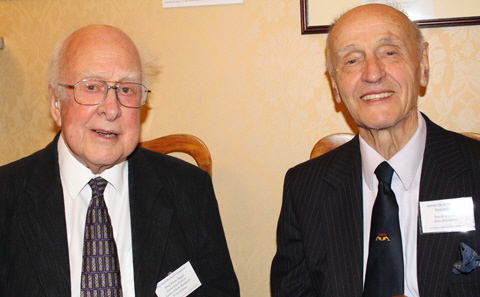
Honorary Patron Professor Peter Higgs (left) with Professor David Ritchie, one of the founders of the JCM Foundation.
Founders
- Professor David S Ritchie MA FRMetS FRSE (Honorary President) passed away in September 2020, see obituary in the Winter 2020 Newsletter
- Professor Sydney Ross PhD HonDSc CorrFRSE (Founder) passed away in December 2013, see obituary in the Spring 2014 Newsletter