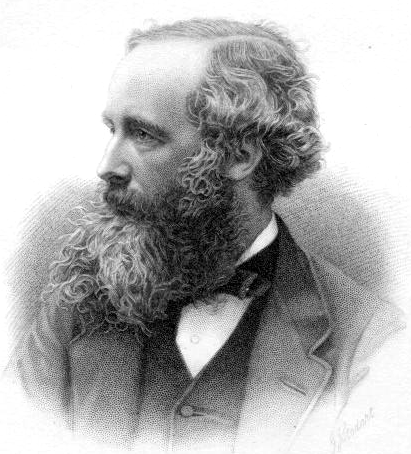
Save Parton Kirk Appeal (Maxwell's burial place)
Birthplace, 14 India Street, Edinburgh
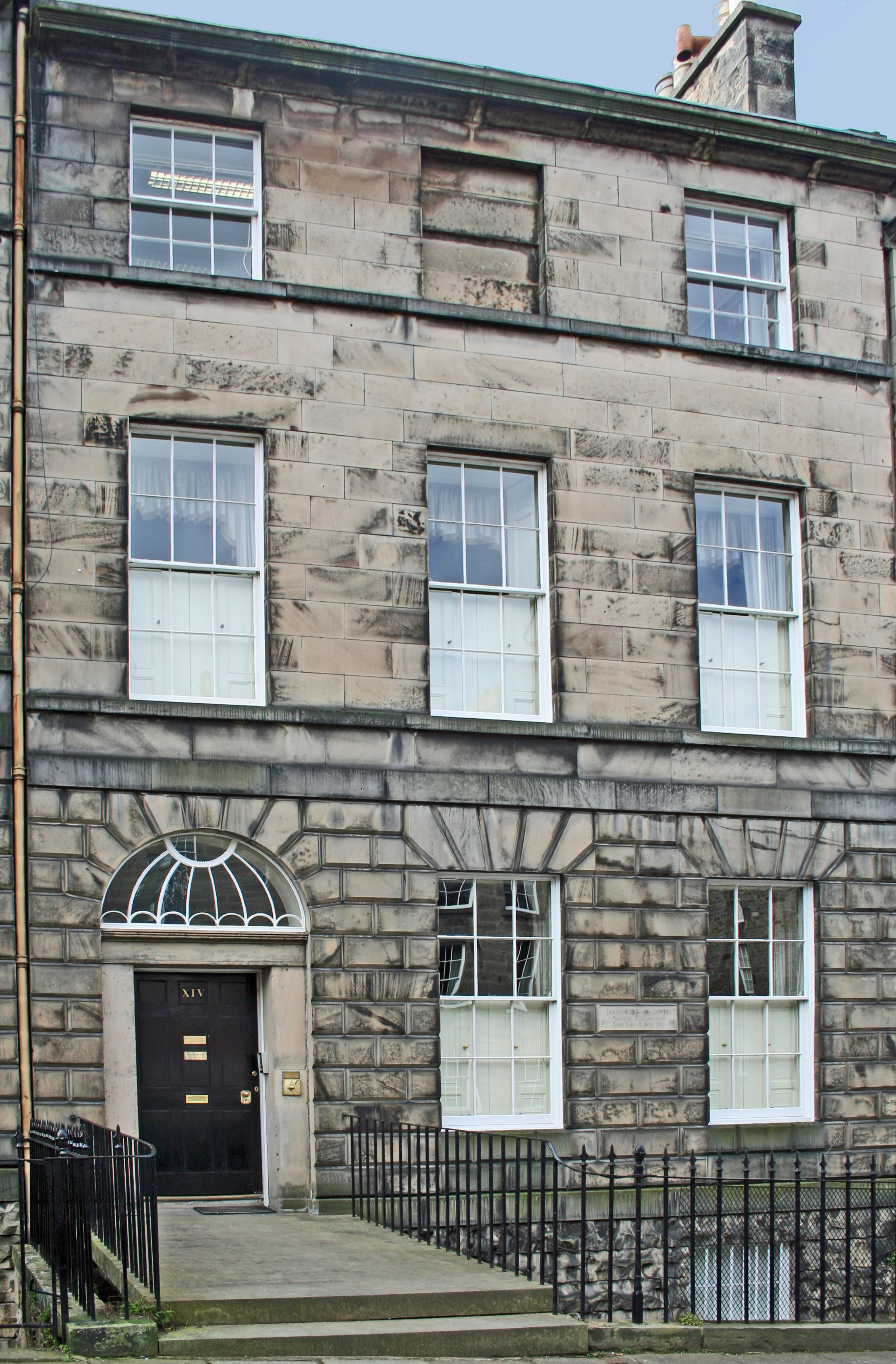
14 India Street

The entrance hallway of the house.
14 India Street, in Edinburgh's ‘New Town' is a substantial terrace house, built for Maxwell's father in 1820. James was born there in 1831. He was only a few months old when the family left Edinburgh to return to Glenlair, their country estate in the south of Scotland; but he came back to Edinburgh to attend school at The Edinburgh Academy and the The University of Edinburgh. He inherited the house on his father's death and retained it throughout his life, finally bequeathing it to his wife on his death in 1879.
The Foundation acquired the house in 1993 and has, to a large extent, retained the original character of the house, while introducing as unobtrusively as possible some alterations that are necessary for its occupancy as a museum and meeting facility, such as central heating, precautions against fire, and security systems. Repairs and restorations were made with the assistance of the Architectural Heritage Fund and the National Heritage Fund.
The former dining room displays memorabilia in the form of portraits, manuscripts, and books associated with Maxwell, his family, and his scientific contemporaries. Descendants on both the paternal and maternal sides of Maxwell's family have donated portraits, furniture, and water colours.
Tours of the house can normally be arranged by prior appointment. Please see our visits page.
Artworks and other items of note on display
Bronze of Maxwell
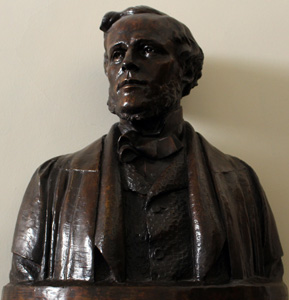
In the entrace hall, we have a copy of the original bronze in Aberdeen University by Charles D'Orville Pilkington Jackson, F.R.B.S., F.R.S.A.. By kind permission of the University of Aberdeen and of the trustees of the late C. d'O. Pilkington Jackson Trust.
The Cay family portraits
Gift of Miss Barbara Wallis.
- ROBERT HODSHON CAY LL.D. (1758-1810) Grandfather of James Clerk Maxwell. Judge of the High Court of Admiralty of Scotland; Friend of Sir Walter Scott. Painted by Isabella Cay (1850-1934) in oils, after Sir Henry Raeburn.
- ELIZABETH CAY, née LIDDELL (1770-1831) Grandmother of James Clerk Maxwell. Self portrait in pastels. The following four portraits of her offspring when they were children are also by her.
- JANE CAY (1797-1876) Aunt of James Clerk Maxwell. Portrait in pastels by her mother, Elizabeth Cay (see above.)
- ROBERT DUNDAS CAY (1807-1888) Uncle and lawyer of James Clerk Maxwell. Registrar of the Supreme Court, Hong Kong. Portrait in pastels by his mother, Elizabeth Cay
- JOHN CAY, F.R.S.E. (1790-1865) Uncle of James Clerk Maxwell. Sheriff of Linlithgow. Portrait in pastels by his mother, Elizabeth Cay.
- FRANCES CAY (1792-1839) Mother of James Clerk Maxwell together with her sister JANE CAY (1797-1876) Portrait in pastels by their mother, Elizabeth Cay.
Maxwell, his Father and Tait portraits
- JOHN CLERK MAXWELL (1787-1856) The portrait of John Clerk Maxwell, father of James Clerk Maxwell and original owner of 14 India Street, is a copy of the original at Penicuik House. By Sir John Watson Gordon, courtesy of Sir John Clerk.
- JAMES CLERK MAXWELL Gift of David S. Ritchie, F.R.S.E. The portrait of James Clerk Maxwell is a copy of the original in Trinity College, Cambridge by Lowes Dickinson. By kind permission of the Master and Fellows of Trinity College.
- PETER GUTHRIE TAIT, F.R.S.E. (1831-1901) Peter Guthrie Tait was a life-long friend of James Clerk Maxwell. His portrait in oils is by Harrington Mann and is the gift of Jens and Carol Högel.
Aunt Jane Cay's Chair and Watercolours
- A MAXWELL CHAIR This chair is from Aunt Jane Cay's home at 6 Great Stuart Street, Edinburgh. It is on permanent loan from James Brown, a descendant of the Cay family. It is embroidered in cross-stitch by Jane Cay to illustrate the wave theory of light. James Clerk Maxwell would sit in this chair to do his homework when staying with his aunt as a schoolboy at the Edinburgh Academy.
- AUNT JANE'S DRAWING ROOM The two watercolours showing the drawing room of Aunt Jane Cay's house are by her. They feature, respectively, Jane Cay herself seated in the chair described above, and James Clerk Maxwell as a schoolboy at the tea-table. The former watercolour is a gift from David S. Ritchie (Trustee) and the latter is on permanent loan from James Brown (see above.)
Watercolours by Jemima Wedderburn featuring JCM
Maxwell's first cousin, Jemima Blackburn, née Wedderburn, eight years older than he, demonstrated a precocious talent for drawing and painting. She drew in water colours nearly every day, maintaining a visual diary of incidents going on around her. Not much escaped her eye, that of a born diarist and artist, and her young cousin James came to be included frequently in the family groups that she delighted to portray. The early years of his life were those in which the cousins were most frequently together, and consequently we have in her work good representations of family events, showing Maxwell as a small boy, usually in the presence of his father. Many of these sketches of unique biographical interest are now in the possession of the Foundation and are on display in the house. They are:
- A family play featuring JCM and Wedderburn children.
- A family party featuring JCM and Wedderburn children.
- JCM with his father at the Highland Cattle Show.
- JCM and Jemima paddling in washing tubs on the River Urr.
- Jemima and her mother being led on horseback by JCM and his father at Glenlair.
- The Wedderburns arrive at Glenlair by at night.
- JCM and his father at Newton en route to Glenlair.
- JCM and his father arriving by horse-drawn coach at 31 Heriot Row, Edinburgh, to stay with the Wedderburns.
- JCM and his father awaiting the arrival of the early steamship at Granton Pier.
- Family picnic on the shore at Roshven, Lochailort, home of the Blackburns. JCM as an adult while at Marischal College, Aberdeen.
- The Foundation also possesses an album of watercolours by Jemima, depicting her journeys in Italy.
The Stairway Gallery of Illustrissimi
Another highlight on display is the Stairway Gallery of Illustrissimi: framed engraved portraits of illustrious mathematicians and physicists arranged in chronological order as one ascends the two flights of stairs. Many of these engravings are from the personal collection of Sir John Herschel (1792-1871), which was sold at a Sotheby auction, 3-4 March 1958. Undeniably, because of this source, there is a pro-British bias to the selection of great names.
We have a searchable high resolution print archive of these and other prints in our collection.
Other
A COMMEMORATIVE OAK SETTLE OF 1695
The oak settle in the entrance hall bears the following inscription:
THIS 1695 OAK SETTLE WAS KINDLY DONATED
TO
THE JAMES CLERK MAXWELL FOUNDATION
BY
THE BANK OF SCOTLAND
TO MARK THE TERCENTENARY OF THE BANK IN 1995
RESTORATION
An upstairs doorway bears the following inscription:
This restored archway was unveiled on
7th March 1994
by
LORD JAMES DOUGLAS-HAMILTON, M.P.
Minister for Education at The Scottish Office
To mark the generous contribution
Of The Scotttish Office
To the acquisition of this house
By the
JAMES CLERK MAXWELL FOUNDATION